
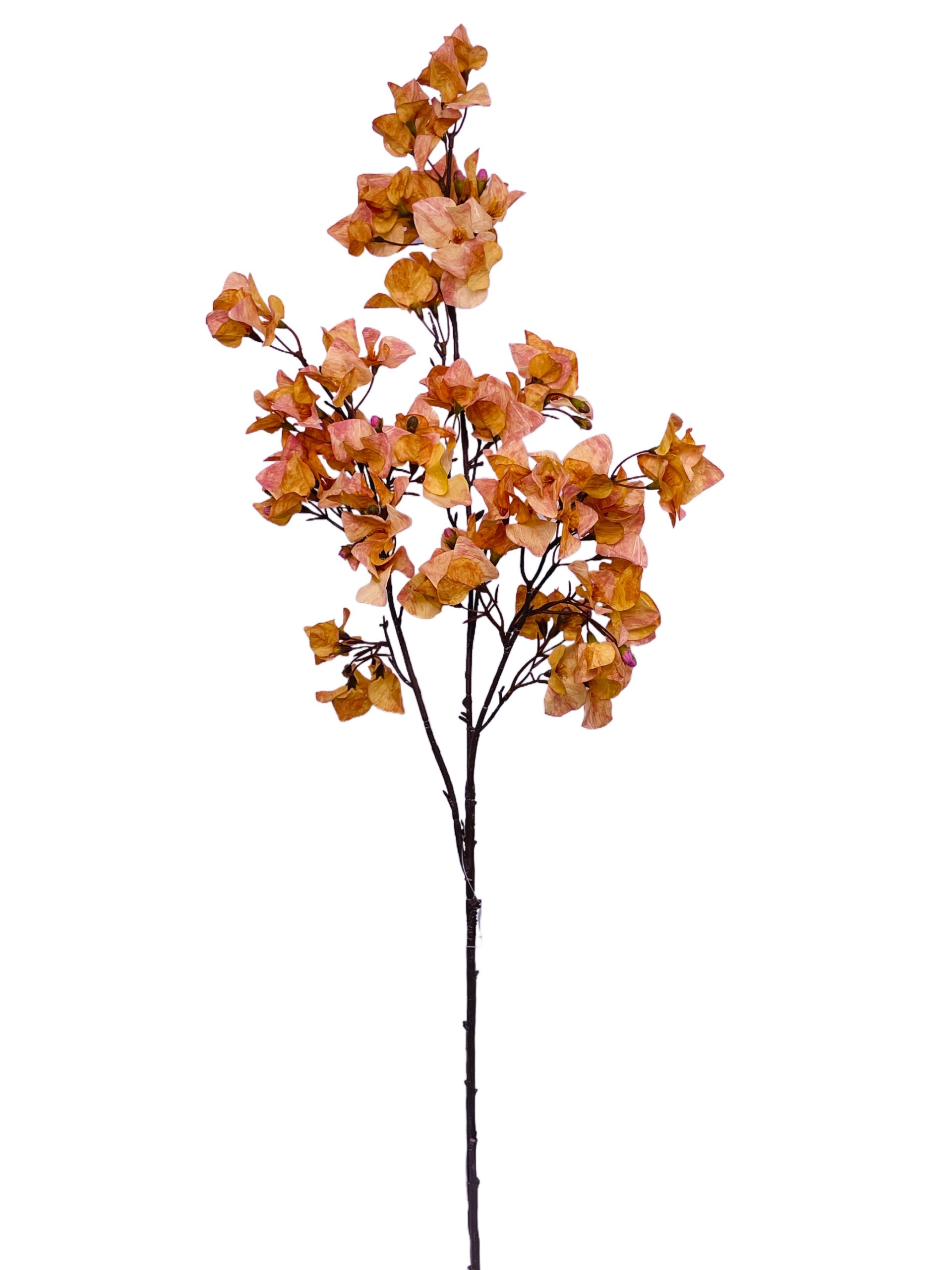
Silk cloth artificial flowers have become favorites in the decoration field due to their soft texture and long-lasting ornamental period. Although their production process is not as complex as precision industrial manufacturing, it still requires strict adherence to steps, with each step being crucial to the aesthetic appeal and simulation degree of the finished product. Below, we will break down the entire production process of silk cloth artificial flowers around six core steps—”Fabric Cutting, Manual Dyeing, Mold Shaping, Injection Molding of Stems, Manual Flower Head Covering, and Manual Assembly of Flower Heads onto Stems”—revealing this production system that combines craftsmanship and manual work.
Step 1: Fabric Cutting – Laying the Foundation for Flower Shape
Fabric cutting is the initial link in the production of silk cloth artificial flowers. Its core goal is to transform the entire piece of silk cloth into petal and leaf raw materials with uniform size and matching shape, laying the groundwork for subsequent shaping. This step requires precise control to avoid dimensional deviations that could affect the regularity of the final flower shape.
First, flower shape templates need to be made according to the design drawings. Templates are usually made of hard plastic or thin metal, individually crafted based on the size of the petals (e.g., small inner petals, large outer petals), shape (round, oval, pointed, etc.), and the outline of the leaves. Each template must have a smooth edge and clear lines for repeated use. For mass production, combined templates are also made, which can cut multiple identical parts at once to improve efficiency.
Next, fabric fixing and cutting operations are carried out. The pre-treated silk cloth (mostly simulated silk or high-elastic chemical fiber silk) is laid flat on a smooth workbench, and the corresponding flower shape template is fixed on the silk cloth with clamps to prevent displacement during cutting. For small-batch production or custom-made products, workers use special sharp scissors to cut evenly along the edge of the template with uniform force to avoid fraying or skewing of the silk cloth. For large-scale production, electric cutting machines are used. The template is fixed on the machine’s cutting table, and after setting the cutting parameters, the machine can automatically cut along the edge of the template, completing 30-50 petals per minute with a dimensional error controlled within 0.1cm.
After cutting, the parts need to be initially screened. The cut petals and leaves are placed in categories, and checked for fraying, missing corners, dimensional discrepancies, and other issues. Unqualified parts must be removed in a timely manner to ensure that all fabric parts entering the next link meet production standards.
Step 2: Manual Dyeing – Endowing Natural Colors
Natural flowers come in a rich variety of colors. The manual dyeing process uses manual operations to make the originally single-color silk cloth parts present colors similar to real flowers, and can even create more creative gradient and mixed-color effects. It is a key step in improving the simulation degree of silk cloth artificial flowers.
Before dyeing, dye preparation and setup are required. According to design requirements, environmentally friendly water-based dyes (fading-resistant and harmless to the human body) are selected, mixed with water in proportion in a special color mixing container, and stirred evenly. For gradient effects, dyes of the same color system with different concentrations need to be prepared; for simulating spots or patterns on petals, additional dark dyes and fine brushes are required. At the same time, tools such as dyeing tanks, fixing agents, water tanks, and drying racks need to be prepared to ensure a smooth dyeing process.
Subsequently, the manual dyeing process begins. Workers hold the cut silk cloth parts (3-5 pieces at a time to avoid overlapping affecting dyeing uniformity) and gently put them into the prepared dye tank, controlling the soaking time (usually 5-15 minutes) according to the desired color depth. During soaking, the parts need to be gently turned to ensure uniform dyeing everywhere. For parts requiring gradient effects, workers immerse part of the component in high-concentration dye and the other part in low-concentration dye, achieving color transition by controlling the time difference in soaking. For parts requiring spot patterns, after the overall dyeing and drying, a fine brush is dipped in dark dye to dot spots of varying sizes on the petals, simulating the shape of natural flowers.
After dyeing, fixing and drying processes are required. The dyed parts are placed in a container with a fixing agent solution for 5-10 minutes to prevent fading during subsequent use. Then, the parts are taken out, gently rinsed with clean water to remove residual dye and fixing agent on the surface, laid flat on a drying rack, and dried in a low-temperature drying room (temperature controlled at 40-60℃). Regular checks are required during drying to avoid fabric deformation due to excessive temperature. Once the parts are completely dry, they can enter the next shaping link.
Step 3: Mold Shaping – Creating Three-Dimensional Forms
Untreated silk cloth parts are soft and flat, unable to present the three-dimensional curvature of natural flowers. The mold shaping link uses special molds and heating equipment to make silk cloth parts form fixed three-dimensional shapes, such as the curl of petals and the raised veins of leaves, making artificial flowers more realistic.
Before shaping, mold and equipment preparation are required. According to the shape of petals and leaves, corresponding metal shaping molds are selected (the surface of the mold is engraved with petal textures or leaf vein patterns to ensure detailed presentation after shaping). At the same time, check if the temperature of the heat gun (used to heat the silk cloth to fit the mold) is normal, usually set at 80-120℃ (the temperature varies slightly for different fabrics, with lower temperature for simulated silk and higher for chemical fiber silk). Auxiliary tools such as tweezers and gloves (to prevent scalding during operation) are also prepared.
The shaping operation needs to be carried out in detailed steps. Taking petal shaping as an example, workers first put on heat-insulating gloves, lay the dry petals flat in the concave surface of the shaping mold, and gently adjust the position of the petals with tweezers to ensure that the edges of the petals are aligned with the edges of the mold and the texture parts are fully attached to the mold patterns. Then, hold the heat gun at a distance of about 10-15cm from the petals, blow hot air evenly on the petal surface, and gently press the petals with tweezers to make them closely fit the mold. The heating time is controlled according to the thickness of the petals, usually 10-20 seconds. After the silk cloth is heated and softened to fully fit the mold shape, stop heating and let the petals cool naturally in the mold for 1-2 minutes. Once the shape is fixed, use tweezers to take the petals out of the mold.
Leaf shaping is similar to petal shaping, but the focus is on highlighting vein details. Lay the leaves flat on the mold with vein patterns, and focus on heating the vein pattern areas during heating to make the silk cloth form raised veins along the patterns, simulating the three-dimensional sense of real leaves. After shaping, all parts need to be checked to ensure full shape, clear texture, no deformation or damage. Qualified parts can enter the assembly link.
Step 4: Injection Molding of Stems – Building Support Structures
Stems are the supporting skeleton of silk cloth artificial flowers, requiring both a certain degree of hardness and the color and texture of natural flower stems. The injection molding link uses plastic injection molding technology to mass-produce stems with uniform specifications and realistic shapes, providing a stable foundation for subsequent flower head assembly.
Before injection molding, mold design and raw material preparation are completed. First, design stem injection molds according to the overall height of the artificial flower, stem thickness (usually 0.3-1.2mm in diameter), and details such as thorns and nodes. Molds are generally made of stainless steel, with stem textures engraved inside (such as small protrusions simulating bark texture), and can inject multiple stems at once to improve production efficiency. For raw materials, environmentally friendly PP or PE plastic (with good toughness and hardness, not easy to break) is selected, and green color masterbatch is added in proportion to ensure that the injected stems present a natural green color. At the same time, the plastic raw materials need to be dried in a dryer (to remove moisture and avoid bubbles during injection molding) at a drying temperature of about 80-90℃ for 2-3 hours.
Next, injection molding production operations are carried out. The dried plastic raw materials are added to the hopper of the injection molding machine. The raw materials are heated and melted in the barrel (temperature about 180-220℃, adjusted according to the plastic material) to form a molten plastic melt. Then, the screw of the injection molding machine injects the melt into the cavity of the stem mold at a certain pressure (usually 50-100MPa). The melt cools and solidifies in the cavity to form the stem shape. During injection molding, strict control of injection temperature, pressure and time is required. Excessively high temperature may cause stem discoloration and deformation, while insufficient pressure may lead to material shortage and unclear texture.
After injection molding, demolding and trimming are carried out. After the mold cools to room temperature (about 10-15 minutes), open the mold and take out the formed stems. At this time, the stems may have gate residues (residual plastic at the entrance where the melt enters the cavity during injection molding). Special scissors are used to trim the residual parts. At the same time, check the stems for bubbles, cracks, uneven color and other defects. Unqualified stems need to be recycled and remelted, while qualified stems are placed in categories waiting for flower head assembly.
Step 5: Manual Flower Head Covering – Assembling Petals into Flower Shapes
Manual flower head covering is the process of assembling shaped petals into a complete flower head in a certain order and structure. This step requires workers to control the arrangement angle and layering of petals based on experience, ensuring that the flower head is full and symmetrical, conforming to the growth laws of natural flowers.
Before covering the flower head, preparation work is required. Classify the shaped petals by size (usually divided into small inner petals, medium middle petals, and large outer petals). At the same time, prepare flower cores (composed of fine iron wire, simulated pistils and stamens), hot melt glue guns (for fixing petals), and workbenches (equipped with fixing clamps for easy operation). Workers need to be familiar with the petal arrangement of the flower shape in advance. For example, roses usually use 5-6 small inner petals, 8-10 medium middle petals, and 12-15 large outer petals, with each layer of petals arranged alternately to present a full flower shape.
When officially covering the flower head, first fix the flower core. Fix the iron wire part of the flower core on the workbench with a clamp, apply a small amount of hot melt glue to the bottom of the flower core, take a small inner petal, align the bottom of the petal with the bottom of the flower core, and press gently to adhere and fix the petal to the flower core. Then, paste the remaining inner petals in turn clockwise or counterclockwise, keeping the angle between each petal uniform (e.g., the angle between inner petals of roses is about 60°) to ensure the flower head is centrally symmetrical.
After pasting the inner petals, start pasting the middle petals. The middle petals need to be staggered outward at a certain angle (about 15-20°) compared to the inner petals. When pasting, first apply glue to the bottom of the petals, then paste them around the inner petals in turn. After pasting each petal, gently adjust the curvature of the petal with tweezers to make it stretch naturally outward, while ensuring no obvious gaps between the petals and distinct layers. Finally, paste the outer petals, which need to be further expanded outward to simulate the blooming shape of flowers. When pasting, pay attention to the height of the petals, gradually decreasing from the inside to the outside to form a natural circular flower head outline.
After covering the flower head, preliminary trimming is required. Gently adjust the position and angle of the petals with tweezers, remove excess hot melt glue residues, check if the flower head is symmetrical and full, and if there is a risk of petal falling off. After confirming qualification, place the flower head on a special tray waiting for assembly with the stem.
Step 6: Manually Attaching Flower Heads to Stems – Completing Overall Assembly
This is the final step in the production of silk cloth artificial flowers. By connecting the made flower heads with injection-molded stems, a complete artificial flower finished product is formed. During operation, it is necessary to ensure firm connection, and adjust the angle between the stem and the flower head to make the overall shape closer to the growth posture of natural flowers.
Before assembly, prepare connection tools and materials. In addition to the made flower heads and stems, prepare hot melt glue guns (for fixing flower heads and stems), tweezers, scissors (for trimming stem length), and a small amount of green silk cloth tape (for covering connection parts to improve aesthetics). Workers need to trim the stems to the specified length with scissors according to design requirements (usually the length from the bottom of the flower head to the end of the stem is 15-30cm, adjusted according to application scenarios such as flower arrangement and decorative bouquets).
During official assembly, first process the top of the stem. Apply a uniform layer of hot melt glue to the top of the stem (about 1-2cm), with a moderate thickness. Excessively thick glue will cause overflow and affect aesthetics, while excessively thin glue will result in insecure connection. Then, align the flower core iron wire hole at the bottom of the flower head (reserved during flower head covering) with the top of the stem, and insert it gently with an insertion depth of about 0.5-1cm to ensure close fit between the flower head and the stem. After insertion, hold the flower head gently by hand for 3-5 seconds to allow the hot melt glue to initially solidify and avoid flower head falling off.
Next, perform detailed processing. If there are hot melt glue residues at the connection between the stem and the flower head, gently scrape them off with tweezers. For further beautification, paste one end of the green silk cloth tape at the connection part, then wrap it down along the stem. During wrapping, apply a small amount of hot melt glue every 2-3cm to fix it until it reaches the specified position. Finally, paste the end of the silk cloth tape firmly to make the connection part more natural and enhance the durability of the stem.
Finally, inspect and adjust the finished product. Observe whether the overall shape of the artificial flower is natural, whether the flower head is firm, and whether the stem is bent or deformed. If there are any problems, correct them in a timely manner. Qualified finished products will be placed in categories, waiting for subsequent packaging and delivery, and finally enter application scenarios such as home decoration and gifts.